Introduction
The phrase servant leadership sounds almost contradictory at first — leaders are supposed to lead, not serve, right? But this leadership philosophy, first articulated by Robert Greenleaf decades ago, has proven remarkably effective in building high-performing, loyal teams. This guide explains what servant leadership actually looks like in practice, and why it consistently outperforms more traditional command-and-control approaches.
What Servant Leadership Actually Means
Quick answer: Servant leadership is a leadership philosophy where the leader’s primary role is to serve their team’s growth and wellbeing first, trusting that empowered, supported employees naturally drive better business results than employees managed through top-down control.
Rather than leading by authority and directives, servant leaders focus on removing obstacles, developing their team’s skills, and creating an environment where people can do their best work.
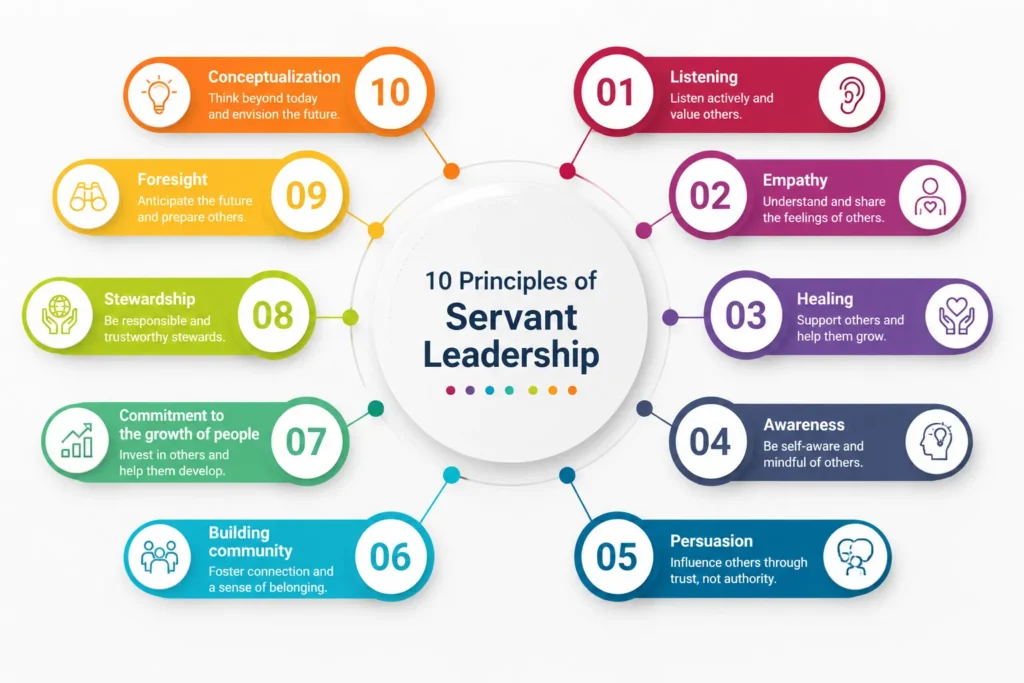
Core Principles of Servant Leadership
- Listening actively — genuinely understanding team concerns before responding
- Empathy — considering team members’ perspectives and circumstances
- Commitment to growth — actively investing in employees’ professional development
- Building community — fostering genuine connection within the team
- Stewardship — taking responsibility for the team’s wellbeing, not just output
How Servant Leadership Differs From Traditional Leadership
Traditional leadership often centers authority at the top, with directives flowing downward and employees expected to execute without much input. Servant leadership flips this — the leader supports the team from below, asking “what do you need to succeed” rather than simply assigning tasks.
This doesn’t mean servant leaders avoid making tough decisions — it means those decisions are made with the team’s genuine best interest as the primary lens, not just short-term output metrics.
Why Servant Leadership Drives Better Team Performance
Teams led by servant leaders consistently show higher engagement and lower turnover, largely because employees feel genuinely supported rather than simply managed. When people trust that their leader has their back, they’re far more willing to take initiative and voice concerns early, before small problems become big ones.
Quick answer: Servant leadership improves team performance primarily by increasing trust and psychological safety, which research consistently links to higher engagement, better collaboration, and lower employee turnover compared to more authoritarian management styles.
Common Misconceptions About Servant Leadership
- It’s often mistaken for being a “soft” or weak leadership style
- People assume servant leaders avoid accountability — they don’t
- It’s sometimes confused with simply being agreeable to every request
In reality, servant leaders hold high standards — they just pair those standards with genuine support rather than pressure alone.
Practical Ways to Practice Servant Leadership
Start with regular one-on-ones focused genuinely on the employee’s challenges and growth, not just status updates. Ask “what’s blocking you” more often than “what have you finished,” and actually follow through on removing those blockers.
[link to related guide on how to lead a remote team here]
Challenges of Implementing Servant Leadership
It requires more time investment than directive leadership, especially early on, and can be misread as indecisiveness if not paired with clear communication about the leader’s own expectations and standards.
FAQs
Q1: Is servant leadership suitable for every industry or team type? It works well across most industries, though fast-moving crisis situations sometimes require more directive leadership temporarily, even from servant leaders.
Q2: How is servant leadership different from being a pushover manager? Servant leaders still hold clear standards and accountability — the difference is they achieve results through support and trust rather than authority and pressure alone.
Q3: Can servant leadership work in a highly hierarchical corporate structure? Yes, though it requires more intentional effort, since traditional hierarchies aren’t naturally designed around this leadership philosophy.
Q4: Does servant leadership slow down decision-making? It can involve more consultation, but effective servant leaders still make timely decisions — the goal is informed decisions, not endless deliberation.
Q5: What’s a simple first step to becoming a more servant-oriented leader? Start by asking your team what obstacles are slowing them down, and actually prioritize removing those obstacles before assigning new tasks.
Q6: Do employees generally prefer servant leadership over traditional leadership? Most research and employee surveys consistently show a strong preference for supportive, servant-style leadership over purely authoritative management.
Conclusion
Servant leadership isn’t about being passive or avoiding hard calls — it’s about genuinely prioritizing your team’s growth and success as the path to better business results. Leaders who practice this consistently build stronger, more loyal teams that perform well even without constant oversight. Start small: in your next one-on-one, spend more time listening than directing, and notice how the conversation shifts.
Suggested Alt Text: “Leader practicing servant leadership by supporting and coaching team members”